A poorly insulated crawl space costs you money every month and lets East Texas humidity work its way up into your floors and walls. The right insulation and moisture barrier stops that cycle for good.
Crawl space insulation in Longview, TX creates a thermal barrier between the ground and your living floors, reducing heat gain in summer and heat loss in winter - most standard jobs on a Longview home are completed in one day, with all removed material hauled away by the crew.
In East Texas, crawl space insulation is not just an energy upgrade - it is a moisture management problem. The clay-heavy soils around Longview hold water after every rain and release moisture upward constantly, even when there is no standing water visible. Without a proper thermal barrier and vapor control, that moisture moves into your floor joists, subfloor, and eventually into your living space. Many older Longview homes with pier-and-beam foundations were never insulated below, or have insulation that has long since sagged and absorbed enough moisture to become useless.
For homes where the moisture problem has been significant, we often recommend pairing insulation with our crawl space vapor barrier service to address both the thermal and moisture issues in a single project.
If your kitchen or living room floor feels warmer than the rest of the house in July, or noticeably cold in January, the crawl space beneath those floors is not insulated well. In Longview's climate, where summer heat is intense and winters are damp, this temperature bleed-through is one of the clearest signs that insulation is missing, damaged, or has fallen away from the floor joists above.
A persistent musty or earthy odor inside your home - especially near floor vents or in rooms over the crawl space - often means moisture has been sitting in that space long enough to grow mold. Given Longview's high humidity, this happens faster here than in drier climates. The smell will not go away on its own, and it usually means the crawl space needs both moisture control and new insulation.
If your electric bill has been creeping up over the past year or two and nothing obvious has changed, a poorly insulated crawl space may be forcing your HVAC system to run longer. This is especially common in older Longview homes where original insulation has degraded over decades of exposure to East Texas humidity and has stopped providing meaningful resistance.
If you open your crawl space access hatch and look inside with a flashlight, you should see insulation snugly fitted between the floor joists. If it is hanging down, visibly wet or stained, covered in mold, or simply missing in patches, it is no longer doing its job. This is direct visual confirmation that replacement is needed - you do not need to be an expert to recognize the difference.
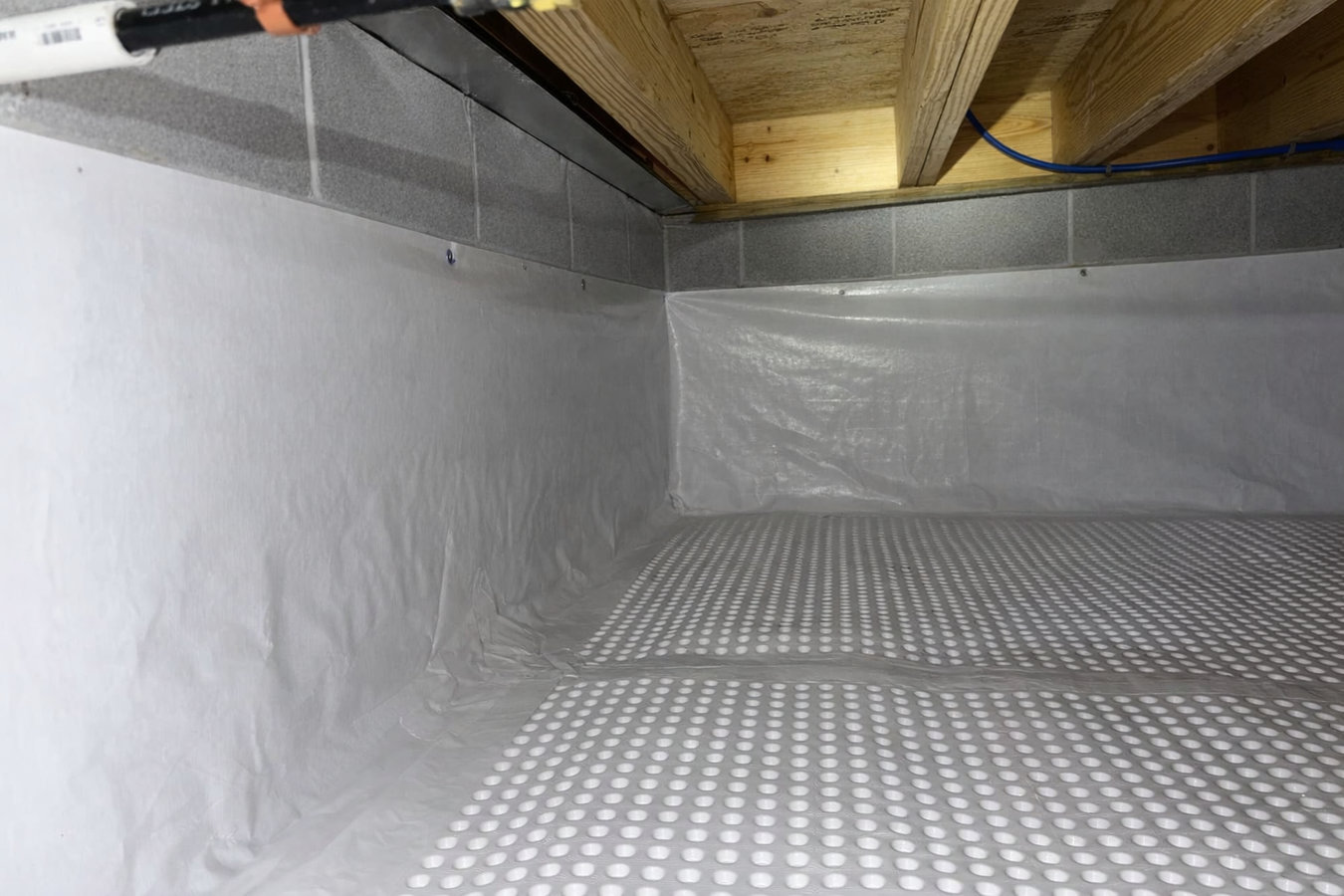
We install crawl space insulation using fiberglass batts fitted between floor joists, rigid foam board on crawl space walls, and spray foam for sealing gaps and penetrations around pipes and wires. For homes where moisture is the primary concern, we recommend the encapsulated crawl space approach - sealing the walls, installing a ground-level vapor barrier, and insulating the perimeter rather than the floor above. This treats the entire space as part of your home's conditioned envelope, which performs better in the consistently humid conditions across East Texas.
Every installation includes checking the condition of any existing material and removing anything that is damaged, wet, or pest-contaminated before new insulation goes in. We also link seamlessly to our wall insulation service for homeowners who want to address the full envelope at once - combining crawl space and wall work in a single project reduces overall scheduling and labor time.
Best for vented crawl spaces in good condition where the goal is a straightforward thermal upgrade without full encapsulation.
Used in encapsulated, unvented crawl spaces where the walls and ground are sealed to control moisture from below.
Addresses the pipe and wire penetrations, rim joists, and foundation sill plate areas where air and moisture sneak in.
For Longview homes with persistent moisture issues - combines insulation, vapor barrier, and vent sealing in one coordinated project.
Longview sits in the Piney Woods region of East Texas, where summer humidity regularly climbs above 80 percent and average highs push into the mid-90s from June through August. Unlike northern states where crawl spaces freeze and dry out in winter, Longview's winters are mild and often wet, which means crawl spaces here stay damp almost year-round. The soils around Gregg County contain significant clay content that holds water after every rain and slowly releases it upward - directly into your crawl space if the ground is not covered by a proper barrier. For homeowners here, moisture control is not a bonus feature of crawl space insulation; it is the whole point.
Many of Longview's established neighborhoods - including older homes near downtown and in areas served from Nacogdoches to Lufkin - have homes on pier-and-beam foundations built in the 1950s through 1980s. The original insulation in these homes, if any was installed at all, is often decades old, compressed, or water-damaged. If your home was built before 1990 and has never had crawl space work done, there is a good chance the space underneath your floors is working against you.
The U.S. Department of Energy's crawl space guidance notes that in humid climates, an encapsulated crawl space often outperforms a traditionally vented one - advice that applies directly to East Texas conditions.
We respond within 1 business day. We ask a few basic questions about your home's age and what you have noticed - cold floors, musty smells, high bills - so we can come prepared. No commitment to ask questions.
A contractor visits and physically inspects the crawl space - checking existing insulation, looking for moisture and pest signs, and assessing accessibility. This takes 30 to 60 minutes. You receive a written estimate explaining what was found and what is recommended, before any commitment is made.
The crew removes any old or damaged material, addresses moisture prep including vapor barrier if included, then installs the new insulation. Most standard Longview homes are done in one full day. You can be home - the crew works in the crawl space and stays out of your living areas.
Before leaving, the crew documents the finished space with photos and walks you through what was done. All removed material is hauled away. If a city inspection is required for the project, we coordinate that on your behalf - you do not need to chase down the appointment yourself.
We inspect your crawl space in person and give you a written estimate - no guesswork, no pressure.
(430) 267-1839A large share of Longview's older neighborhoods were built on pier-and-beam foundations, not slabs. We work in these crawl spaces regularly and know what to expect - the access challenges, the typical moisture patterns, and the materials that need to come out before anything new can go in.
Most homeowners do not want to crawl under their house to verify the work. We document the space before and after with photos so you can see exactly what condition it was in and what was installed - without having to go in yourself.
One of the biggest concerns homeowners have is watching a price climb once work is underway. We give you a written estimate after a real inspection, and that number does not change unless something genuinely unexpected is found and explained to you first.
Crawl space moisture in this region is not a seasonal problem - it is year-round. We install vapor barriers and insulation systems designed to handle the persistent humidity and clay-soil moisture migration that homeowners throughout Gregg County deal with every day.
The North American Insulation Manufacturers Association sets installation guidelines we follow on every job. When the work is done to a recognized standard - and you have the photos to prove it - you can trust that your crawl space is actually protected.
Once the crawl space is addressed, upgrading wall insulation closes the remaining gaps in your home's thermal envelope.
Learn moreA proper vapor barrier on the crawl space floor is a separate but closely related service - often installed alongside insulation for full moisture control.
Learn moreLongview summers do not wait - the sooner your crawl space is properly insulated and sealed, the sooner your home stops losing ground to East Texas heat and humidity.