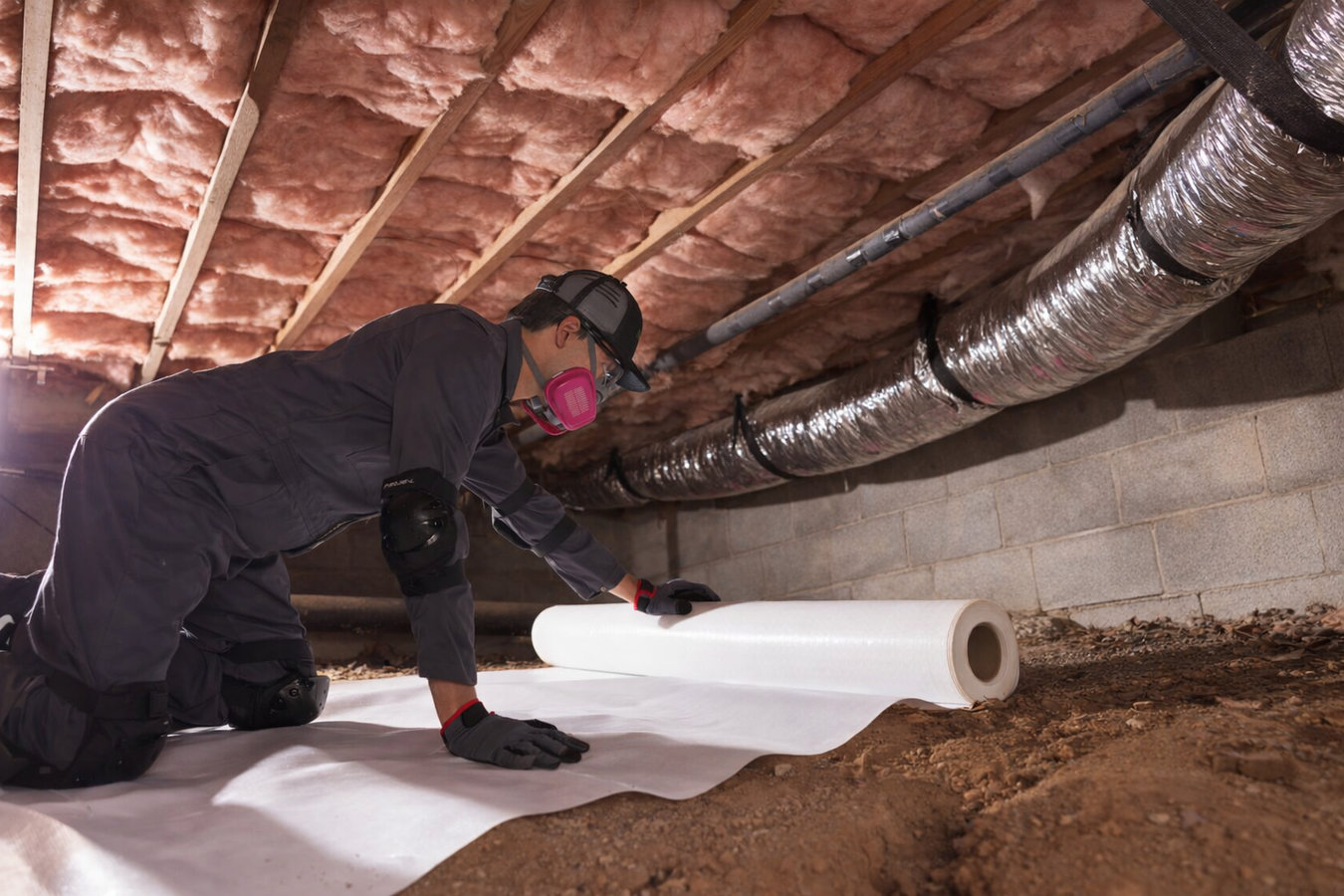
Ground moisture rising through your crawl space is one of the most common causes of floor damage and musty odors in East Texas homes. Vapor barrier installation seals it off for good.
Vapor barrier installation in Longview, TX means laying heavy plastic sheeting across the floor of your crawl space - and sealing every seam and edge so ground moisture cannot get through - most standard jobs are completed in a single day without disrupting anything inside your home.
In Longview, where the soil is heavy clay and annual rainfall averages around 47 inches, the ground under your home stays saturated for days after rain events. That moisture rises upward into the air beneath your floor system, and over time it soaks into wood framing, floor joists, and insulation. The damage is slow and invisible - which is exactly what makes it so costly when you finally notice it. Homes in older Longview neighborhoods built on pier-and-beam foundations are the most vulnerable, especially if no moisture protection was ever installed.
If you want to address moisture control across a broader scope - including basement walls or a full sealed crawl space approach - our crawl space vapor barrier service covers targeted floor-level installation as a focused starting point.
If you notice spots in your floor that give a little when you walk on them, or an area that used to feel solid now has some flex, moisture damage to the wood underneath is a likely cause. In Longview's older pier-and-beam homes, this is one of the most common signs that ground moisture has been working on the floor joists for years. Catching it early limits how much structural repair you will eventually need.
A persistent musty smell - particularly noticeable when you first walk in the door or after a wet stretch - is a strong signal that mold or mildew is growing somewhere in your home's structure. In Longview, where heavy clay soil stays wet for days after a storm, crawl spaces are the most common source of that smell. If the odor comes and goes with the weather, the crawl space is almost certainly the culprit.
Longview summers are long and hot, and air conditioning runs hard from May through September. But if your cooling bills seem higher than your neighbors' or higher than they used to be, moisture in the crawl space may be making your system work harder than it should. Damp air rising from below is harder to condition, and your system never quite catches up.
Many homes built in Longview before the mid-1980s were constructed without moisture protection in the crawl space. If you have never had a barrier installed and your home sits on a pier-and-beam foundation, you have likely been living with uncontrolled ground moisture for years. A quick inspection through the access hatch - or a free contractor assessment - can tell you exactly what you are dealing with.
We install vapor barriers across the full crawl space floor, overlapping every seam by at least six inches and taping them so moisture cannot work through the gaps. The edges run up the foundation walls and are fastened in place - not just laid flat on the ground - because an unsealed edge is a moisture pathway. The thickness we use by default is heavier than the minimum required, because in East Texas the ground is under constant moisture pressure and thinner material degrades faster. We also clear the space and remove any old deteriorated plastic before the new barrier goes in, since covering wet soil or debris with new plastic defeats the purpose entirely. Homeowners who want to go further can pair vapor barrier installation with retrofit insulation for walls and attic spaces, addressing both moisture and thermal performance in one coordinated project.
For homes where a basic floor barrier is not enough - such as those with persistent moisture even after installation, visible mold on the framing, or very high humidity readings under the house - we discuss full encapsulation as a next step. Full encapsulation seals the walls and sometimes the ceiling of the crawl space and may include a dehumidifier. We give honest recommendations based on what we actually find in your space, not on which option costs more.
The core service for most Longview homes - complete coverage with sealed seams and wall terminations that stop ground moisture at the source.
For homes where existing plastic has torn, shifted, or deteriorated over time and is no longer providing meaningful protection.
Includes debris removal and any standing water management before the barrier goes down - so the new material performs from day one.
For homes with persistent moisture problems where a basic floor barrier alone may not be sufficient - we assess and recommend honestly.
Longview averages around 47 inches of rain per year, and the clay-heavy soil across Gregg County holds that water near the surface for days after a storm - instead of draining away quickly the way sandier soils do. The city's mild winters mean ground moisture does not take a seasonal break the way it does in colder climates. For the large number of Longview homes built on pier-and-beam foundations - many in neighborhoods like Pine Tree, Judson, and the areas near downtown that were developed from the 1950s through the 1980s - that persistent moisture pressure is a year-round problem. The Department of Energy identifies crawl space moisture control as one of the most cost-effective home improvements available in humid climates, and East Texas qualifies on that count without question.
We regularly work in communities across the region that share Longview's climate and housing profile. Homeowners in Tyler and Carthage deal with the same East Texas clay soil and older housing stock, and the moisture problems we find under their homes look essentially identical to what we encounter in Longview. The solution is the same too: a properly installed, heavy-duty barrier with sealed seams and wall terminations that holds up through years of regional humidity.
The U.S. Department of Energy moisture control guidance explains why crawl space vapor barriers are particularly valuable in humid climates. The Insulation Contractors Association of America publishes best practices for moisture control installation that guide our approach on every job.
We get back to you within one business day. We will ask basic questions - the age and foundation type of your home, and whether you have noticed any specific signs like odors or soft floors - so we can come to the estimate prepared.
We access your crawl space - typically through an exterior hatch or interior closet - and spend 20 to 45 minutes checking the soil condition, any existing material, clearance, and whether there is standing water or mold present. We walk you through what we found before we leave, at no charge.
You receive an itemized written estimate covering the barrier material, labor, and any prep work. This is the time to ask questions about thickness, seam sealing, and wall termination. A reputable contractor answers clearly and does not pressure you to decide on the spot.
The crew clears the space, removes old material if present, installs the barrier with overlapping taped seams and fastened wall edges, and then walks you through the completed work. There is no curing time - the barrier is working from the moment installation is complete.
Free estimate, no obligation. We reply within one business day and come to you.
(430) 267-1839Longview's clay soil, older pier-and-beam housing stock, and Gregg County building permit process are things we work with on every job in this area. You get a crew that understands what your crawl space is up against - not a crew learning as they go.
We install thicker barrier plastic than the lightest option available because East Texas humidity is relentless and the ground here stays wet far longer than in drier climates. A heavier barrier lasts longer, holds up to crawl space access, and gives you a 15-to-25-year installation rather than one that needs attention in a few years.
Old material comes out before the new barrier goes in. Debris gets cleared. Standing water gets addressed. These steps are included in every job - not added to your bill as a surprise after the estimate. Installing a barrier over a wet or cluttered crawl space is not something we do.
Before we pack up, we walk you through the finished installation. Crawl space work is out of sight, and we understand that means you need to be shown - not just told - that the job was completed correctly. Every customer gets that walkthrough as a standard part of the service.
Our approach is straightforward: show up prepared, install the barrier correctly using quality materials, and make sure every customer can see exactly what was done before we leave. That combination is what earns repeat calls and referrals in Longview's close-knit neighborhoods.
Retrofit insulation adds thermal protection to walls and attics in existing homes - a natural follow-up after vapor barrier work addresses moisture at the crawl space level.
Learn moreA crawl space vapor barrier is the focused solution for homes that need ground moisture blocked at the dirt floor specifically.
Learn moreEast Texas wet season does not wait. Call now or request a free estimate and have your crawl space assessed before moisture does more damage.